
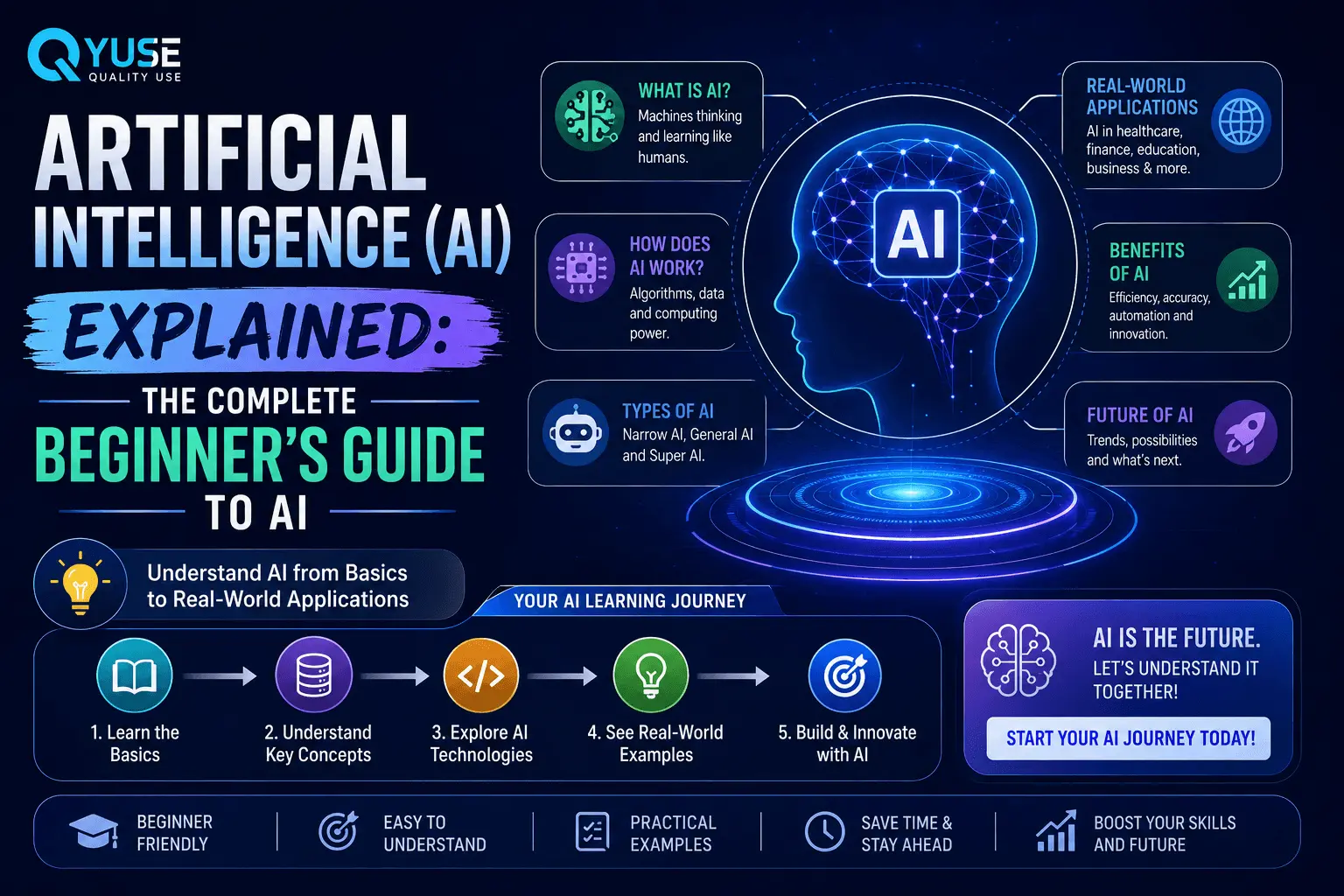

Learn everything about Artificial Intelligence in 2026. Discover how AI works, its types, applications, benefits, challenges, and future impact on technology, business, and everyday life.
Table of Contents
ToggleIntroduction
Artificial Intelligence, commonly known as AI, has become one of the most transformative technologies of the modern era. From search engines and smartphones to healthcare systems and autonomous vehicles, AI is rapidly changing how people live, work, and interact with technology.
A few years ago, AI seemed like a futuristic concept found only in science fiction movies. Today, it is part of everyday life. Whether you use voice assistants, recommendation systems, chatbots, or navigation apps, you are already interacting with artificial intelligence.
In 2026, AI continues to revolutionize industries, improve productivity, and create new business opportunities. At the same time, it raises important questions about privacy, ethics, employment, and the future of humanity.
This complete beginner’s guide explains what AI is, how it works, its major applications, benefits, challenges, and what the future may hold.
What Is Artificial Intelligence?
Artificial Intelligence refers to the ability of machines or computer systems to perform tasks that normally require human intelligence.
These tasks include:
- Learning
- Reasoning
- Problem solving
- Decision making
- Language understanding
- Pattern recognition
Rather than simply following fixed instructions, AI systems can analyze data, identify patterns, and improve performance over time.
In simple terms, AI enables computers to mimic certain aspects of human thinking.
A Brief History of AI
The concept of artificial intelligence dates back several decades.
1950s
Researchers began exploring machine intelligence.
1960s–1980s
AI development focused on expert systems and rule-based programs.
1990s
Computing power increased significantly.
2010s
Machine learning and deep learning transformed the field.
2020s
Generative AI systems became widely accessible to businesses and consumers.
Today, AI development continues at an unprecedented pace.
How AI Works
AI systems learn from data.
The basic process includes:
Data Collection
Large amounts of information are gathered.
Training
Algorithms analyze patterns within the data.
Prediction
The system uses learned patterns to make decisions or predictions.
Improvement
Performance improves as additional data becomes available.
This process allows AI to become increasingly accurate over time.
Types of Artificial Intelligence
AI can be categorized into different levels.
Narrow AI
Also called Weak AI.
Designed to perform specific tasks.
Examples:
- Voice assistants
- Recommendation engines
- Translation tools
Most AI systems today fall into this category.
General AI
General AI would perform intellectual tasks similarly to humans across multiple domains.
This level has not yet been achieved.
Superintelligent AI
A theoretical form of AI that would exceed human intelligence.
Currently, this remains speculative.
Machine Learning Explained
Machine Learning is a subset of AI.
Instead of being explicitly programmed for every situation, machine learning systems learn from data.
Examples include:
- Fraud detection
- Search ranking
- Product recommendations
- Spam filtering
Machine learning powers many modern AI applications.
Deep Learning
Deep Learning is a specialized branch of machine learning.
It uses artificial neural networks inspired by the human brain.
Deep learning excels at:
- Image recognition
- Speech recognition
- Natural language processing
Many advanced AI systems rely on deep learning technology.
Natural Language Processing (NLP)
NLP allows computers to understand human language.
Applications include:
- Chatbots
- Translation systems
- Voice assistants
- Content generation
Modern conversational AI systems use advanced NLP techniques.
Computer Vision
Computer Vision enables machines to interpret visual information.
Applications include:
- Facial recognition
- Medical imaging
- Autonomous vehicles
- Security systems
Computer vision continues improving rapidly.
AI in Everyday Life
Many people use AI daily without realizing it.
Examples include:
Search Engines
Deliver relevant results.
Streaming Platforms
Recommend movies and shows.
Social Media
Personalize feeds.
Smartphones
Improve photography and voice recognition.
Navigation Apps
Optimize routes and traffic predictions.
AI has become deeply integrated into modern life.
AI in Business
Businesses increasingly use AI to improve operations.
Applications include:
Customer Support
AI chatbots provide instant assistance.
Marketing
Personalized campaigns improve engagement.
Data Analysis
AI identifies trends and opportunities.
Automation
Routine tasks can be automated.
Organizations adopting AI often gain competitive advantages.
AI in Healthcare
Healthcare is one of the most promising AI sectors.
AI supports:
- Disease diagnosis
- Medical imaging
- Drug discovery
- Patient monitoring
These technologies can improve efficiency and patient outcomes.
AI in Education
Educational institutions use AI to:
- Personalize learning
- Automate assessments
- Improve accessibility
Students receive more customized educational experiences.
AI in Cybersecurity
Cybersecurity professionals use AI for:
- Threat detection
- Malware analysis
- Network monitoring
AI helps identify attacks faster than traditional methods.
AI in Content Creation
Content creators use AI to:
- Generate ideas
- Draft articles
- Create images
- Edit content
AI has become an important productivity tool for bloggers and marketers.
AI Tools Popular in 2026
Several AI tools continue gaining popularity.
Examples include:
- AI writing assistants
- Image generators
- Research assistants
- Coding assistants
- Productivity platforms
These tools help individuals and businesses work more efficiently.
Benefits of Artificial Intelligence
AI offers numerous advantages.
Increased Productivity
Automation reduces repetitive work.
Better Decision Making
Data analysis improves accuracy.
Cost Reduction
Efficiency lowers operational expenses.
Faster Innovation
Organizations develop solutions more quickly.
Improved User Experiences
Personalization enhances satisfaction.
AI creates opportunities across many industries.
Challenges and Risks of AI
Despite its benefits, AI presents challenges.
Privacy Concerns
AI systems often require large amounts of data.
Bias
Poor-quality data can produce unfair outcomes.
Job Displacement
Automation may affect certain professions.
Security Risks
Malicious actors may misuse AI technologies.
Responsible development is essential.
AI and Employment
Many people worry AI will replace jobs.
In reality, AI is likely to:
- Automate repetitive tasks
- Create new opportunities
- Change existing roles
Workers who adapt and learn AI-related skills may benefit significantly.
AI Ethics
Ethical considerations include:
- Transparency
- Accountability
- Fairness
- Privacy
Organizations must develop AI responsibly.
Ethical AI builds trust and reduces risks.
The Future of Artificial Intelligence
Several trends are shaping the future.
Smarter AI Systems
Models continue becoming more capable.
Multimodal AI
AI increasingly understands text, images, audio, and video simultaneously.
Personalized Experiences
Services become more customized.
Greater Automation
More industries adopt AI-powered workflows.
Improved Accessibility
Technology becomes easier to use.
The future of AI appears highly transformative.
AI Opportunities for Website Owners
Website owners can leverage AI for:
Content Creation
Generate ideas and drafts.
SEO Optimization
Improve search visibility.
Customer Support
Deploy intelligent chatbots.
Analytics
Understand user behavior.
For platforms like Qyuse, AI can accelerate content production and audience growth.
AI and SEO
Search engines increasingly use AI technologies.
Website owners should focus on:
- High-quality content
- User experience
- Search intent
- Expertise
Helpful content remains the foundation of SEO success.
Common AI Myths
Myth 1: AI Thinks Like Humans
AI processes data differently than people.
Myth 2: AI Will Replace Everyone
Most experts expect transformation rather than complete replacement.
Myth 3: AI Is Always Accurate
AI systems can make mistakes.
Understanding limitations is important.
How Beginners Can Start Learning AI
Start with:
- Online courses
- Tutorials
- AI tools
- Educational blogs
- Practical experimentation
Hands-on learning often produces the best results.
Why AI Matters in 2026
AI is becoming a foundational technology similar to the internet and smartphones.
Understanding AI helps individuals:
- Improve productivity
- Build careers
- Grow businesses
- Stay competitive
Knowledge of AI is increasingly valuable.
Final Thoughts
Artificial Intelligence is transforming nearly every aspect of modern life. From healthcare and education to business and cybersecurity, AI continues creating opportunities and challenges.
While the technology is advancing rapidly, its greatest value comes from helping people solve problems, increase efficiency, and unlock new possibilities.
For beginners, the best approach is to understand the fundamentals, explore practical tools, and stay informed about ongoing developments.
As AI continues evolving throughout 2026 and beyond, those who learn and adapt will be well-positioned to benefit from one of the most important technological revolutions in history.
Introduction
Artificial Intelligence, commonly known as AI, has become one of the most transformative technologies of the modern era. From search engines and smartphones to healthcare systems and autonomous vehicles, AI is rapidly changing how people live, work, and interact with technology.
A few years ago, AI seemed like a futuristic concept found only in science fiction movies. Today, it is part of everyday life. Whether you use voice assistants, recommendation systems, chatbots, or navigation apps, you are already interacting with artificial intelligence.
In 2026, AI continues to revolutionize industries, improve productivity, and create new business opportunities. At the same time, it raises important questions about privacy, ethics, employment, and the future of humanity.
This complete beginner’s guide explains what AI is, how it works, its major applications, benefits, challenges, and what the future may hold.
What Is Artificial Intelligence?
Artificial Intelligence refers to the ability of machines or computer systems to perform tasks that normally require human intelligence.
These tasks include:
- Learning
- Reasoning
- Problem solving
- Decision making
- Language understanding
- Pattern recognition
Rather than simply following fixed instructions, AI systems can analyze data, identify patterns, and improve performance over time.
In simple terms, AI enables computers to mimic certain aspects of human thinking.
A Brief History of AI
The concept of artificial intelligence dates back several decades.
1950s
Researchers began exploring machine intelligence.
1960s–1980s
AI development focused on expert systems and rule-based programs.
1990s
Computing power increased significantly.
2010s
Machine learning and deep learning transformed the field.
2020s
Generative AI systems became widely accessible to businesses and consumers.
Today, AI development continues at an unprecedented pace.
How AI Works
AI systems learn from data.
The basic process includes:
Data Collection
Large amounts of information are gathered.
Training
Algorithms analyze patterns within the data.
Prediction
The system uses learned patterns to make decisions or predictions.
Improvement
Performance improves as additional data becomes available.
This process allows AI to become increasingly accurate over time.
Types of Artificial Intelligence
AI can be categorized into different levels.
Narrow AI
Also called Weak AI.
Designed to perform specific tasks.
Examples:
- Voice assistants
- Recommendation engines
- Translation tools
Most AI systems today fall into this category.
General AI
General AI would perform intellectual tasks similarly to humans across multiple domains.
This level has not yet been achieved.
Superintelligent AI
A theoretical form of AI that would exceed human intelligence.
Currently, this remains speculative.
Machine Learning Explained
Machine Learning is a subset of AI.
Instead of being explicitly programmed for every situation, machine learning systems learn from data.
Examples include:
- Fraud detection
- Search ranking
- Product recommendations
- Spam filtering
Machine learning powers many modern AI applications.
Deep Learning
Deep Learning is a specialized branch of machine learning.
It uses artificial neural networks inspired by the human brain.
Deep learning excels at:
- Image recognition
- Speech recognition
- Natural language processing
Many advanced AI systems rely on deep learning technology.
Natural Language Processing (NLP)
NLP allows computers to understand human language.
Applications include:
- Chatbots
- Translation systems
- Voice assistants
- Content generation
Modern conversational AI systems use advanced NLP techniques.
Computer Vision
Computer Vision enables machines to interpret visual information.
Applications include:
- Facial recognition
- Medical imaging
- Autonomous vehicles
- Security systems
Computer vision continues improving rapidly.
AI in Everyday Life
Many people use AI daily without realizing it.
Examples include:
Search Engines
Deliver relevant results.
Streaming Platforms
Recommend movies and shows.
Social Media
Personalize feeds.
Smartphones
Improve photography and voice recognition.
Navigation Apps
Optimize routes and traffic predictions.
AI has become deeply integrated into modern life.
AI in Business
Businesses increasingly use AI to improve operations.
Applications include:
Customer Support
AI chatbots provide instant assistance.
Marketing
Personalized campaigns improve engagement.
Data Analysis
AI identifies trends and opportunities.
Automation
Routine tasks can be automated.
Organizations adopting AI often gain competitive advantages.
AI in Healthcare
Healthcare is one of the most promising AI sectors.
AI supports:
- Disease diagnosis
- Medical imaging
- Drug discovery
- Patient monitoring
These technologies can improve efficiency and patient outcomes.
AI in Education
Educational institutions use AI to:
- Personalize learning
- Automate assessments
- Improve accessibility
Students receive more customized educational experiences.
AI in Cybersecurity
Cybersecurity professionals use AI for:
- Threat detection
- Malware analysis
- Network monitoring
AI helps identify attacks faster than traditional methods.
AI in Content Creation
Content creators use AI to:
- Generate ideas
- Draft articles
- Create images
- Edit content
AI has become an important productivity tool for bloggers and marketers.
AI Tools Popular in 2026
Several AI tools continue gaining popularity.
Examples include:
- AI writing assistants
- Image generators
- Research assistants
- Coding assistants
- Productivity platforms
These tools help individuals and businesses work more efficiently.
Benefits of Artificial Intelligence
AI offers numerous advantages.
Increased Productivity
Automation reduces repetitive work.
Better Decision Making
Data analysis improves accuracy.
Cost Reduction
Efficiency lowers operational expenses.
Faster Innovation
Organizations develop solutions more quickly.
Improved User Experiences
Personalization enhances satisfaction.
AI creates opportunities across many industries.
Challenges and Risks of AI
Despite its benefits, AI presents challenges.
Privacy Concerns
AI systems often require large amounts of data.
Bias
Poor-quality data can produce unfair outcomes.
Job Displacement
Automation may affect certain professions.
Security Risks
Malicious actors may misuse AI technologies.
Responsible development is essential.
AI and Employment
Many people worry AI will replace jobs.
In reality, AI is likely to:
- Automate repetitive tasks
- Create new opportunities
- Change existing roles
Workers who adapt and learn AI-related skills may benefit significantly.
AI Ethics
Ethical considerations include:
- Transparency
- Accountability
- Fairness
- Privacy
Organizations must develop AI responsibly.
Ethical AI builds trust and reduces risks.
The Future of Artificial Intelligence
Several trends are shaping the future.
Smarter AI Systems
Models continue becoming more capable.
Multimodal AI
AI increasingly understands text, images, audio, and video simultaneously.
Personalized Experiences
Services become more customized.
Greater Automation
More industries adopt AI-powered workflows.
Improved Accessibility
Technology becomes easier to use.
The future of AI appears highly transformative.
AI Opportunities for Website Owners
Website owners can leverage AI for:
Content Creation
Generate ideas and drafts.
SEO Optimization
Improve search visibility.
Customer Support
Deploy intelligent chatbots.
Analytics
Understand user behavior.
For platforms like Qyuse, AI can accelerate content production and audience growth.
AI and SEO
Search engines increasingly use AI technologies.
Website owners should focus on:
- High-quality content
- User experience
- Search intent
- Expertise
Helpful content remains the foundation of SEO success.
Common AI Myths
Myth 1: AI Thinks Like Humans
AI processes data differently than people.
Myth 2: AI Will Replace Everyone
Most experts expect transformation rather than complete replacement.
Myth 3: AI Is Always Accurate
AI systems can make mistakes.
Understanding limitations is important.
How Beginners Can Start Learning AI
Start with:
- Online courses
- Tutorials
- AI tools
- Educational blogs
- Practical experimentation
Hands-on learning often produces the best results.
Why AI Matters in 2026
AI is becoming a foundational technology similar to the internet and smartphones.
Understanding AI helps individuals:
- Improve productivity
- Build careers
- Grow businesses
- Stay competitive
Knowledge of AI is increasingly valuable.
Final Thoughts
Artificial Intelligence is transforming nearly every aspect of modern life. From healthcare and education to business and cybersecurity, AI continues creating opportunities and challenges.
While the technology is advancing rapidly, its greatest value comes from helping people solve problems, increase efficiency, and unlock new possibilities.
For beginners, the best approach is to understand the fundamentals, explore practical tools, and stay informed about ongoing developments.
As AI continues evolving throughout 2026 and beyond, those who learn and adapt will be well-positioned to benefit from one of the most important technological revolutions in history.
Helpful article Artificial Intelligence Guide:
- Web DevelopmentWebsite Growth How to Build a Premium Website with WordPress in 2026
- Best AI Tools for Online Business & Productivity in 2026
- Beginner’s Guide to Crypto Futures Trading in 2026
- Affiliate Marketing for Beginners: How to Start Earning Online in 2026
- Best Free WordPress Plugins for Speed, SEO & Security in 2026
- How to Grow a New Website with SEO in 2026
- Top Remote Work Skills That Can Make Money Online in 2026


