

.COM vs .NET vs .ORG: Which Should You Choose? Compare trust, purpose, cost, SEO, and branding to find the right domain for your website today.
Choosing a domain extension can affect how people perceive your website. This detailed guide compares .COM vs .NET vs .ORG for branding, trust, SEO, business, blogs, nonprofits, developers, and online stores so you can confidently choose the right extension.
.COM is usually the best choice for businesses, commercial websites, bloggers, and personal brands because it is familiar and easy to remember. Choose .ORG when your website represents a nonprofit, community, or mission-driven organization. Choose .NET when the website has a technology, networking, infrastructure, or internet-related purpose. SEO performance itself is not determined by choosing .COM, .NET, or .ORG.
Table of Contents
ToggleIntroduction
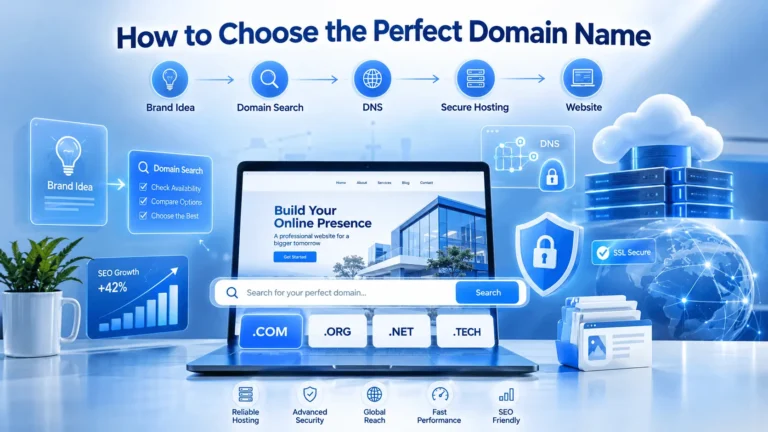
Choosing a domain extension is one of those decisions that looks simple until you actually start registering a website. You search for your perfect name, discover that the .COM is already taken, and suddenly you are wondering whether .NET or .ORG would be a smarter choice.
That is exactly why understanding .COM vs .NET vs .ORG: Which Should You Choose? matters before you spend money on a domain.
Your domain is more than a web address. It becomes part of your brand, email address, marketing materials, social profiles, business cards, and customer experience. A memorable domain can make your website easier to recognize, while a confusing extension can sometimes create unnecessary friction.
The good news is that there is no universal rule saying every website must use .COM.
A commercial business, for example, will usually benefit from .COM. A nonprofit or community organization may communicate its purpose more clearly with .ORG. Meanwhile, a technology company, network service, or developer-focused project may find .NET perfectly appropriate.
There is also an important SEO misconception to clear up.
Google says that the top-level domain itself does not determine how well a website performs in Google Search. Google’s systems aim to return relevant and useful results regardless of whether a site uses .COM, .ORG, .NET, or another generic top-level domain.
So this isn’t simply a question of which extension “ranks higher.”
Instead, the better question is:
Which extension best matches your brand, audience, purpose, and long-term plans?
In this guide, we’ll compare .COM, .NET, and .ORG from the perspective of branding, credibility, SEO, pricing, availability, business use, WordPress, ecommerce, blogging, development, and nonprofit organizations.
By the end, you should have a clear answer instead of simply choosing whichever extension happens to be available.
What Are .COM, .NET, and .ORG?
Explain:
- What a domain extension is
- What TLD means
- Historical purpose of each extension
- How modern usage has evolved
What Does .COM Mean?
Explain commercial use and modern universal adoption.
What Does .NET Mean?
Explain its original network-oriented purpose and modern technology use.
What Does .ORG Mean?
Explain organizations, communities, nonprofits, and mission-driven projects.
.COM vs .NET vs .ORG: Which Should You Choose?
Introduce a simple decision framework:
| Your Website | Recommended Extension |
|---|---|
| Business | .COM |
| Personal brand | .COM |
| Blog | .COM |
| Online store | .COM |
| Nonprofit | .ORG |
| Community | .ORG |
| Technology/networking | .NET |
| Developer project | .NET or .COM |
| Open-source project | .ORG or .COM |
| Commercial SaaS | Usually .COM |
What Is a .COM Domain?
Cover:
- Familiarity
- Brand recognition
- Commercial websites
- Email credibility
- Global audiences
- Availability challenges
- Renewal considerations
Advantages of .COM
- Familiar
- Easy to explain
- Strong commercial association
- Excellent for international brands
- Usually the first extension people type
Disadvantages of .COM
- Many good names are already registered
- Premium domains can be expensive
- Short brandable names can be difficult to find
What Is a .NET Domain?
Cover:
- Original networking purpose
- Technology companies
- Internet services
- Developers
- Infrastructure brands
- When
.NETis a strong alternative to.COM
Advantages of .NET
- Recognizable
- Technology-oriented identity
- Useful when the
.COMis unavailable - Suitable for technical brands
Disadvantages of .NET
- Some users automatically expect
.COM - Less natural for traditional businesses
- Potential type-in confusion
What Is a .ORG Domain?
Cover:
- Nonprofits
- Charities
- Communities
- Educational organizations
- Open-source projects
- Public-interest initiatives
Advantages of .ORG
- Strong organizational identity
- Appropriate for mission-driven projects
- Familiar to internet users
- Excellent fit for communities and nonprofits
Disadvantages of .ORG
- Can feel unusual for a conventional commercial store
- Some customers may assume the organization is nonprofit or community-focused
.COM vs .NET vs .ORG: Key Differences
A detailed comparison table will examine:
- Purpose
- Brand perception
- Trust
- SEO
- Business use
- Nonprofit use
- Technology use
- Availability
- Pricing
- Memorability
Does Domain Extension Affect SEO?
Explain:
- Google’s official position
- Relevance
- Content quality
- Links
- Technical SEO
- Performance
- User experience
- Brand signals
- Why
.COMdoes not receive an automatic Google ranking advantage
Google’s Search documentation states that its systems seek the most relevant results regardless of the top-level domain.
Which Domain Extension Is Most Trusted?
Discuss perception rather than claiming an absolute ranking.
Why .COM Often Feels Familiar
Why .ORG Can Signal Purpose
Why .NET Can Signal Technology
What If Your .COM Domain Is Taken?
Cover:
- Try a different brand name.
- Add a meaningful word.
- Consider a shorter brandable name.
- Check whether the domain is legitimately for sale.
- Consider
.NETif your brand has a technical purpose. - Consider
.ORGif the organization genuinely fits the extension. - Avoid confusing misspellings.
Should You Buy .COM, .NET, and .ORG Together?
Explain when buying multiple extensions makes sense.
Recommended for:
- Established brands
- Companies protecting trademarks
- High-value projects
- Brands likely to be impersonated
Not necessary for:
- Small experimental websites
- Temporary projects
- Low-budget personal sites
Expert Decision Rule
Use this simple framework:
Business → .COM
Personal brand → .COM
Blog → .COM
Online store → .COM
Nonprofit/community → .ORG
Technology/networking → .NET
Developer project → .COM or .NET
Open-source/community project → .ORG or .COM
Important Editorial Note
Domain prices, hosting prices, promotional discounts, renewal rates, storage limits, and included features change frequently. The comparison section in the final article therefore distinguishes advertised introductory pricing from long-term considerations and recommends checking the provider’s current checkout price before purchasing.
For example, Namecheap currently displays promotional pricing for .COM, .NET, and .ORG, while its published renewal prices are higher than some introductory offers.
Likewise, Hostinger currently advertises hosting from $2.99/month on a 48-month term, with a free domain for one year, SSL, CDN, and support included on the displayed Premium plan.
This approach is more trustworthy than presenting a promotional price as though it were a permanent monthly rate.
What Are .COM, .NET, and .ORG?
Before deciding between them, it helps to understand what these three extensions actually represent.
The letters at the end of a domain name are called a top-level domain, or TLD. In a domain such as example.com, example is the second-level domain and .com is the TLD.
.COM, .NET, and .ORG are all generic top-level domains. They are not country-code domains such as .uk, .bd, or .de.
Historically, the three extensions had different purposes.
- .COM was associated with commercial entities.
- .NET was originally associated with network-related organizations.
- .ORG was designed for organizations that did not fit the commercial or network categories.
The web has changed dramatically since those original classifications were established. Today, all three are used in a much wider range of situations.
That means the question is no longer simply about the original technical definition.
It is about what your domain communicates to visitors.
.COM vs .NET vs .ORG: Which Should You Choose?
If you want the shortest possible answer, choose based on the purpose of your website.
Choose .COM if:
- You operate a business.
- You sell products or services.
- You are building a personal brand.
- You run a commercial blog.
- You operate an affiliate website.
- You are building an ecommerce store.
- You want a broadly familiar extension.
Choose .ORG if:
- You operate a nonprofit.
- You manage a community.
- You run a charitable organization.
- You maintain an open-source or public-interest project.
- Your website’s identity is organizational rather than commercial.
Choose .NET if:
- Your company provides networking services.
- Your project is technology-focused.
- You operate infrastructure or internet services.
- You build developer tools.
- Your ideal
.COMis unavailable and.NETfits the brand naturally.
The most important point is this:
Do not choose an extension simply because someone says it is an SEO shortcut.
Google explicitly states that the TLD itself does not determine search performance.
What Is a .COM Domain?
.COM is the extension most people associate with commercial websites, but its modern role is much broader.
A .COM can work for almost any mainstream commercial or personal project.
Imagine telling someone your website address over the phone.
If you say:
“Visit mybrand dot com.”
Most people immediately understand that they are hearing a conventional website address.
That familiarity is one of the biggest advantages of .COM.
Advantages of .COM
1. Strong familiarity
People have been exposed to .COM addresses for decades.
That makes the extension easy to recognize.
2. Excellent for commercial brands
Businesses, agencies, SaaS companies, ecommerce stores, affiliate sites, and service providers can all use .COM naturally.
3. Good international positioning
If your business serves customers across several countries, .COM is a straightforward choice because it does not communicate a specific country.
4. Easy to use in marketing
A .COM domain can be printed on:
- Business cards
- Packaging
- Social media profiles
- Advertisements
- Email signatures
- YouTube descriptions
- QR codes
5. Good long-term flexibility
A small blog may eventually become a company.
A personal website may eventually become a consulting business.
A .COM does not force you into a particular organizational category.
Disadvantages of .COM
The biggest problem is availability.
Because so many businesses and individuals want .COM, many short and obvious names are already registered.
For example, if you want:
smartshop.com
it may already belong to another person or company.
That does not mean you should immediately use:
smart-shop-2026-online-store.com
A better solution is often to create a stronger brand name.
What Is a .NET Domain?
.NET originally had a strong association with network infrastructure and internet services.
That historical connection still makes .NET particularly interesting for technology-related businesses.
A network-management company, developer platform, cloud infrastructure service, hosting company, or internet-focused project can use .NET naturally.
For example, a hypothetical company called:
CloudBridge.net
immediately feels more technical than:
CloudBridge.org
That difference comes from perception rather than an SEO ranking factor.
Advantages of .NET
1. Strong technology association
.NET can work especially well for:
- Hosting companies
- Networking companies
- Developer tools
- Infrastructure platforms
- Internet services
- Technical communities
2. Useful when .COM is unavailable
Suppose your company has a strong brand name but its .COM is already registered.
If your business is technology-focused, .NET may be a much better alternative than using a confusing variation of the brand.
3. Professional appearance
.NET is an established and recognizable extension.
It does not automatically make a website look suspicious or unprofessional.
Disadvantages of .NET
The main weakness is human behavior.
Some people automatically assume that a company uses .COM.
If you own:
Example.net
a customer might accidentally type:
Example.com
That is why you should think carefully about brand confusion before choosing .NET.
For a highly visible consumer brand, protecting the exact .COM may be worthwhile if it is available at a reasonable price.
What Is a .ORG Domain?
.ORG has one of the clearest identities of the three.
It is strongly associated with:
- Nonprofits
- Charities
- Communities
- Educational organizations
- Public-interest projects
- Open-source communities
- Mission-driven initiatives
If your website exists primarily to serve a community rather than sell products, .ORG can communicate that purpose immediately.
For example:
CommunityHealth.org
feels natural.
By contrast:
CommunityHealth.com
could be interpreted as a commercial healthcare company.
Neither is inherently better. They simply communicate different expectations.
Advantages of .ORG
1. Strong organizational identity
.ORG immediately feels appropriate for an organization, initiative, or community.
2. Good fit for nonprofits
Charities and nonprofit organizations can build a consistent identity around .ORG.
3. Suitable for communities
Online communities, public-interest projects, educational initiatives, and open-source projects can also use .ORG.
Disadvantages of .ORG
The main issue is commercial perception.
If you operate an online electronics store, for example, .ORG may create uncertainty.
A visitor could reasonably wonder:
“Is this a nonprofit organization?”
If your purpose is clearly commercial, .COM will usually communicate your intent more naturally.
.COM vs .NET vs .ORG: Key Differences
| Factor | .COM | .NET | .ORG |
|---|---|---|---|
| Main perception | Commercial/general | Technology/networking | Organization/community |
| Best for | Businesses, brands, blogs | Tech and infrastructure | Nonprofits and communities |
| Memorability | Excellent | Good | Good |
| Commercial use | Excellent | Good | Possible, but less natural |
| Nonprofit use | Good | Possible | Excellent |
| Technology use | Excellent | Excellent | Good |
| Blog use | Excellent | Good | Good |
| Ecommerce | Excellent | Possible | Usually not ideal |
| SEO advantage | None inherently | None inherently | None inherently |
| Global use | Excellent | Excellent | Excellent |
| Availability | Often difficult | Often easier | Often easier |
| Brand flexibility | Excellent | Good | Purpose-specific |
The important SEO point is worth repeating: Google says the top-level domain itself does not determine search performance. Relevance and usefulness matter far more.
Does Domain Extension Affect SEO?
This is one of the most common questions surrounding .COM vs .NET vs .ORG.
The answer is surprisingly straightforward.
No, choosing .COM does not automatically give you a Google ranking advantage over .NET or .ORG.
Google’s Search Central documentation explicitly says that its systems aim to return the best and most relevant result regardless of the TLD.
That does not mean the domain extension is irrelevant to your business.
It can influence:
- Brand perception
- Memorability
- Direct traffic
- Customer expectations
- Email credibility
- Offline marketing
- Click confidence
Those are branding and user-experience considerations rather than a simple TLD ranking boost.
What Actually Matters More for SEO?
Focus on:
- Helpful content
- Search intent
- Technical SEO
- Internal linking
- Quality backlinks
- Page experience
- Mobile usability
- Website speed
- Clear site structure
- Search-friendly titles
- Good metadata
- Strong topical coverage
Google’s Search Essentials specifically recommends creating helpful, reliable, people-first content and using language that people would naturally use when searching.
Which Domain Extension Is Most Trusted?
There is no universal trust ranking.
However, different extensions can create different expectations.
.COM
Often feels:
- Commercial
- Established
- Familiar
- Mainstream
- Brand-friendly
.NET
Often feels:
- Technical
- Internet-focused
- Infrastructure-oriented
- Developer-friendly
.ORG
Often feels:
- Organizational
- Community-oriented
- Nonprofit
- Mission-driven
Therefore, “trust” should be considered in context.
A .ORG may be more credible for a charity than a .COM.
A .NET may feel more appropriate for a networking company.
A .COM may feel more natural for an ecommerce brand.
When Should You Choose .COM?
Choose .COM when your primary goal is building a broad commercial or personal brand.
It is especially suitable for:
Businesses
A local service company, agency, consulting firm, manufacturer, or international company can all use .COM.
Bloggers
If your blog may eventually become a business, .COM gives you flexibility.
Affiliate marketers
A commercial affiliate site is usually better aligned with .COM than .ORG.
Ecommerce
Online stores should generally prioritize .COM when a suitable brand name is available.
Personal brands
If you are building a career, portfolio, consultancy, or creator business, .COM is a strong long-term choice.
When Should You Choose .NET?
Choose .NET when technology is genuinely part of the brand identity.
Good examples include:
- Cloud infrastructure
- Networking
- Hosting
- Developer tools
- Technical communities
- Internet services
- API platforms
- IT services
For example, a fictional company called SecureNode could use securenode.net if the .COM is unavailable and its business is focused on networking infrastructure.
The important thing is consistency.
Do not choose .NET merely because it is available if the business has nothing to do with technology.
When Should You Choose .ORG?
Choose .ORG when your website represents an organization, community, nonprofit, charity, or mission-driven initiative.
Good examples include:
- Charitable organizations
- Educational communities
- Open-source projects
- Public-interest groups
- Community organizations
- Volunteer initiatives
If your organization genuinely fits this identity, .ORG can be a powerful branding choice.
What If Your .COM Domain Is Taken?
This is where many new website owners make expensive mistakes.
They find their preferred .COM is unavailable and then register a strange variation containing multiple hyphens, numbers, or unnecessary words.
Instead, follow this process.
Step 1: Improve the brand name
Try a shorter or more distinctive brand.
Step 2: Add a meaningful word
For example:
- GetBrand.com
- UseBrand.com
- BrandHQ.com
- BrandOnline.com
Only do this if the resulting name still sounds natural.
Step 3: Consider .NET
If the business is technical, .NET can be a legitimate alternative.
Step 4: Consider .ORG
Only use .ORG if your organization genuinely fits its expected purpose.
Step 5: Check the aftermarket
If the exact .COM is extremely important, investigate whether it is legitimately available for purchase.
However, never spend a large amount simply because someone tells you .COM is required for SEO.
It is not.
Should You Buy .COM, .NET, and .ORG Together?
Sometimes.
For an established company, buying multiple extensions can be useful for brand protection.
For example, if you own:
Example.com
you might also register:
- Example.net
- Example.org
You can then redirect the additional domains to your primary website where appropriate.
When Multiple Domains Make Sense
Consider multiple extensions if:
- Your brand is valuable.
- You expect significant traffic.
- Your company has a strong trademark.
- Competitor confusion would be costly.
- You use the name heavily offline.
- You want to prevent obvious impersonation.
When You Don’t Need Them
You probably do not need three extensions for:
- A small personal blog
- A temporary project
- A test website
- A hobby site
- A low-budget experiment
Start with one excellent domain.
You can always expand later.
Domain Registration: Look Beyond the First-Year Price
A common mistake is choosing a registrar solely because the first-year promotional price is low.
The better calculation is:
First-year cost + renewal cost + privacy cost + transfer cost + useful included features
For example, Namecheap currently advertises promotional .COM, .NET, and .ORG registration prices, but its published renewal prices are higher than the promotional registration figures.
That is why you should always check:
- Registration price
- Renewal price
- Transfer price
- WHOIS/domain privacy
- DNS management
- Auto-renewal settings
- Support
- Domain locking
- Account security
A $6 first-year domain is not necessarily cheaper if it renews at a significantly higher price.
Recommended Domain Registrar: Namecheap
For readers who mainly need domain registration, Namecheap is a natural option to consider.
Its current domain pricing page shows .COM, .NET, and .ORG registration offers and includes free domain privacy on supported domains.
👉 Register Your Domain with Namecheap
The key advantage is simplicity: you can register the domain separately from your hosting provider.
That can be useful if you want more control over your domain and hosting relationship.
Domain + Hosting: What Comes Next?
Registering a domain gives you the address.
You still need hosting if you want to run a website.
Think of it this way:
Domain = your website’s address
Hosting = the infrastructure where your website lives
WordPress = the software used to build and manage the website
SSL/TLS = encrypted connection between visitors and your website
This distinction becomes especially important for beginners.
Recommended Hosting: Hostinger
For beginners, bloggers, small businesses, and WordPress users, Hostinger is worth considering because its current plans combine hosting, SSL, CDN, WordPress support, backups, and a free domain for one year on eligible plans.
Its current Premium plan is advertised from $2.99/month on a 48-month term, with 20GB SSD storage, a free domain for one year, weekly backups, CDN, and 24/7 priority support. Renewal pricing is higher, so check the current offer before purchasing.
Recommended Hosting: Bluehost
Bluehost is particularly relevant for readers who want WordPress-focused hosting.
Its current WordPress hosting page lists a Starter plan from $3.99/month on a 36-month term, with 10GB NVMe SSD storage, a free domain for the first year, free SSL, CDN, managed WordPress updates, and 24/7 chat support.
Bluehost can therefore make sense for a beginner who wants domain, hosting, WordPress, and basic security features under one provider.
SSL Is Still Important
Your domain extension does not replace website security.
Regardless of whether you choose .COM, .NET, or .ORG, your website should use HTTPS.
Let’s Encrypt provides free TLS certificates and explains that certificates allow websites to enable HTTPS encryption.
For many websites, your hosting provider may already include SSL.
If you need a paid certificate for a specific business, organization, validation, warranty, or compatibility requirement, compare the certificate’s actual benefits before purchasing.
Hosting Comparison: Which Provider Fits Your Domain?
Choosing the right domain extension is only half the equation.
Once you register your domain, you need hosting that matches your website’s traffic, technology, budget, and growth plans.
The following comparison is designed as a practical editorial guide rather than a promise of fixed pricing. Hosting promotions and renewal rates change frequently, so readers should verify the current provider page before purchasing.
| Hosting Provider | Starting Price* | Performance | Storage | Free Domain | SSL | Support | Best For | Rating |
|---|---|---|---|---|---|---|---|---|
| Namecheap | From about $1.98/mo promo | Good | 20GB on selected plan | Yes | Yes | 24/7 | Budget users | 8.5/10 |
| Hostinger | From $2.99/mo | Very Good | 20GB SSD on Premium | Yes, 1 year | Yes | 24/7 | Beginners & blogs | 9.2/10 |
| Bluehost | From $3.99/mo | Very Good | 10GB NVMe | Yes, 1 year | Yes | 24/7 | WordPress | 9.0/10 |
| WebHostingHub | Pricing varies | Good | Plan-dependent | Plan-dependent | Available | 24/7 | Existing WHH users | 7.0/10 |
| InMotion Hosting | From around $2.99/mo promo | Very Good | Plan-dependent | Plan-dependent | Yes | 24/7 | Business & developers | 7.0/10 |
*Promotional pricing can depend on billing term, region, taxes, coupons, and campaign timing. Always check the provider’s checkout page.
For context, Hostinger currently advertises $2.99/month on a 48-month Premium term with 20GB SSD, a one-year free domain, SSL, CDN, weekly backups, and 24/7 support.
Bluehost currently advertises WordPress hosting from $3.99/month on a 36-month term, including 10GB NVMe storage, a first-year domain, SSL, CDN, managed WordPress updates, and 24/7 chat support.
Namecheap currently lists promotional .COM, .NET, and .ORG domain prices and free privacy protection for supported domains.
WebHostingHub remains an available hosting brand, although current plan information is less consistently presented across public sources than the larger providers above. Current third-party listings show plan prices and product information, so buyers should verify the provider’s own checkout before committing.
Best Hosting for Beginners
Winner: Hostinger
Hostinger is a strong beginner choice because its current plans combine:
- Hosting
- SSL
- CDN
- WordPress
- Website tools
- Backups
- Support
- Free domain for one year on eligible plans
The interface is designed to reduce the number of separate technical services a beginner has to manage.
Alternative: Bluehost
Bluehost is also attractive for beginners who specifically want WordPress-focused onboarding and managed WordPress features.
Best Hosting for WordPress
Winner: Bluehost or Hostinger
Both deserve consideration.
Bluehost emphasizes WordPress hosting, managed WordPress updates, free SSL, CDN, and WordPress support.
Hostinger also offers dedicated WordPress hosting with performance, AI tools, CDN, backups, and 24/7 support.
For a first WordPress website, either can be a sensible starting point.
Best Hosting for WooCommerce
Winner: Hostinger
For a small WooCommerce store, Hostinger’s current hosting ecosystem includes integrated ecommerce features and higher-tier plans with more storage and backups.
However, WooCommerce stores should prioritize:
- CPU resources
- RAM
- Object caching
- Database performance
- CDN
- Backups
- Security
- Payment gateway compatibility
- Scalability
The cheapest plan is not always the best WooCommerce plan.
Best Hosting for Business
Winner: InMotion Hosting
For businesses that prioritize resources and support, InMotion Hosting is worth considering.
It is especially relevant when your website is more than a simple blog and you need room for:
- Business applications
- Larger websites
- Client projects
- Development workflows
- Higher resource requirements
Check the current plan and renewal price before buying because hosting offers change.
Best Hosting for Bloggers
Winner: Hostinger
For a new blog, the priorities are usually:
- Affordable hosting
- Easy WordPress installation
- SSL
- Backups
- Good performance
- CDN
- Simple management
Hostinger currently includes many of these features in its entry-level and mid-tier plans.
Best Hosting for Developers
Winner: InMotion Hosting or Hostinger
Developers should look beyond the marketing price.
Consider:
- PHP versions
- SSH access
- Git support
- Cron jobs
- Database options
- Staging
- Server resources
- CDN
- Caching
- Backup tools
- Migration support
For simple projects, Hostinger can be convenient.
For more advanced workloads, InMotion Hosting may deserve a closer look.
Pros and Cons of Each Domain Extension
.COM
Pros
- Familiar
- Flexible
- Excellent for commercial brands
- Easy to market
- Strong global identity
Cons
- Many names unavailable
- Premium domains can be expensive
- Renewal pricing varies by registrar
.NET
Pros
- Established extension
- Strong technology association
- Good alternative when .COM is unavailable
- Suitable for infrastructure brands
Cons
- Some visitors may type .COM
- Less natural for traditional nonprofits
- Less commercially familiar than .COM
.ORG
Pros
- Excellent organizational identity
- Strong nonprofit/community association
- Good for public-interest projects
- Appropriate for open-source communities
Cons
- Less natural for conventional ecommerce
- May cause visitors to assume nonprofit status
- Not ideal when the brand is purely commercial
Real Use Cases
Use Case 1: New Online Store
Imagine you want to launch an electronics store.
You have three available names:
brand.combrand.netbrand.org
Choose:
brand.com
Why?
Because visitors immediately understand that the website is commercial.
Use Case 2: Charity
You are launching a community food-support organization.
Available:
communityhelp.comcommunityhelp.netcommunityhelp.org
Choose:
communityhelp.org
The extension reinforces the organization’s purpose.
Use Case 3: Network Security Company
You launch a company that provides network monitoring.
Available:
securemesh.comsecuremesh.netsecuremesh.org
If .COM is unavailable or too expensive, .NET can be an excellent fit.
Use Case 4: Personal Blog
You want to write about technology, WordPress, SEO, and web hosting.
Choose:
.COM
Even if you start as a blogger, you may later add:
- Affiliate marketing
- Courses
- Consulting
- Digital products
- Sponsorships
A .COM gives the brand room to evolve.
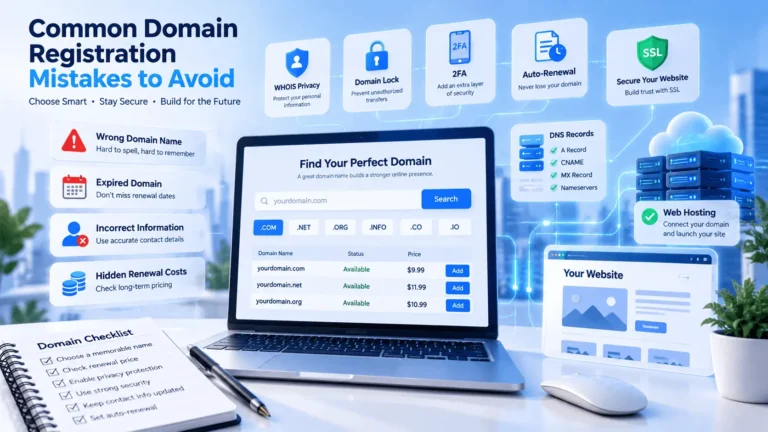
Common Domain Mistakes
Mistake 1: Choosing a TLD Only for SEO
There is no need to choose .COM simply because you believe Google automatically prefers it.
Google’s official guidance says the TLD itself does not determine search performance.
Mistake 2: Ignoring Renewal Pricing
A discounted first year can look attractive.
Always check the renewal price.
Mistake 3: Creating an Awkward Domain
Do not force a complicated name just to obtain .COM.
A memorable .NET can be better than a terrible .COM.
Mistake 4: Using .ORG for a Clearly Commercial Brand
If visitors expect a nonprofit because of your domain extension, you may create unnecessary confusion.
Mistake 5: Forgetting Domain Privacy
Protect your personal information where privacy protection is available.
Namecheap, for example, currently advertises free privacy protection for supported domains.
Mistake 6: Forgetting Auto-Renewal
Losing a valuable domain because it expired can be far more expensive than paying for renewal.
Enable auto-renewal and keep your payment information current.
Expert Tips for Choosing a Domain
Tip 1: Prioritize the Brand
Your domain should sound natural when spoken aloud.
Ask yourself:
“Can someone remember this after hearing it once?”
If not, reconsider the name.
Tip 2: Keep It Short
Shorter is usually easier to remember.
However, do not sacrifice clarity simply to remove a few characters.
Tip 3: Avoid Unnecessary Numbers
Numbers can create confusion.
For example:
Tech4You.com
could be interpreted as:
TechForYou.com
If you use a number intentionally, make sure it is central to the brand.
Tip 4: Avoid Excessive Hyphens
One hyphen may sometimes be acceptable.
Multiple hyphens usually make a domain harder to communicate.
Tip 5: Check Social Availability
Before committing to a brand, check whether the name is available on the major social networks.
Tip 6: Think About Email
Your domain will appear in email addresses.
Compare:
hello@brand.com
with:
hello@brand.net
Both can work, but think about which one customers are more likely to remember.
Tip 7: Check Trademark Issues
Do not build an expensive brand around another company’s protected name.
For WordPress-related sites, WordPress.org itself publishes guidance about using the WordPress trademark in domain names.
Domain Extension and Website Security
Your TLD does not determine whether your website is secure.
Security comes from the infrastructure and practices around the domain.
At minimum, use:
- HTTPS
- Strong passwords
- Two-factor authentication
- Secure WordPress administration
- Regular backups
- Updated plugins
- Updated themes
- Malware monitoring
- Secure hosting
- Domain lock
Let’s Encrypt provides free TLS certificates, making HTTPS encryption accessible to websites without requiring a paid certificate in many situations.
Suggested Video Section
Video: How to Choose the Right Domain Name
Add a short 3–6 minute video explaining:
- What a domain extension is
.COMvs.NETvs.ORG- How to check domain availability
- How to avoid trademark problems
- How to connect the domain to hosting
- How to install WordPress
- How to enable HTTPS
A video makes the article more useful for beginners and gives readers another way to consume the information.
FAQ: .COM vs .NET vs .ORG
1. Is .COM better than .NET?
For most commercial businesses and general-purpose websites, .COM is usually the safer branding choice because it is highly familiar. However, .NET can be an excellent alternative for technology and networking companies.
2. Is .ORG only for nonprofits?
No. .ORG is strongly associated with organizations, nonprofits, communities, and mission-driven projects, but the extension is not technically limited to nonprofits.
3. Does .COM rank higher on Google?
No automatic ranking advantage exists simply because a site uses .COM. Google states that its search systems aim to return relevant results regardless of the top-level domain.
4. Should a business use .ORG?
Usually, .COM is more natural for a conventional commercial business. .ORG can make sense when the business is actually an organization or mission-driven project.
5. Is .NET good for a technology company?
Yes. .NET has a strong technology and networking association, making it a logical choice for infrastructure, networking, hosting, and developer-focused brands.
6. Should I buy all three extensions?
Not necessarily. Buying multiple extensions can help protect a valuable brand, but a small website usually only needs one excellent domain.
7. What should I choose if my .COM is unavailable?
First consider changing the brand name slightly. If the brand is technology-focused, .NET may be a good alternative. If the website is an organization or community, .ORG may be appropriate.
8. Is .ORG good for a blog?
Yes, but .COM is usually more flexible for a commercial or personal blog. .ORG is especially suitable when the blog belongs to a nonprofit, community, or public-interest organization.
9. Is .NET good for WordPress?
Yes. WordPress works with .NET just as it does with .COM and .ORG. The extension itself does not prevent you from running WordPress.
10. Which domain extension should a new business choose?
For most new commercial businesses, .COM is the strongest default. If the exact .COM is unavailable, consider a better brand name before choosing an alternative extension.
Final Recommendation: .COM vs .NET vs .ORG
So, .COM vs .NET vs .ORG: Which Should You Choose?
For most readers, the answer depends on what the website represents.
Choose .COM for:
- Businesses
- Ecommerce
- Blogs
- Affiliate websites
- Personal brands
- Agencies
- SaaS products
- Commercial websites
Choose .NET for:
- Networking companies
- Hosting businesses
- Infrastructure platforms
- Developer tools
- Internet services
- Technology communities
Choose .ORG for:
- Nonprofits
- Charities
- Communities
- Open-source organizations
- Educational initiatives
- Public-interest projects
The most important lesson is that you do not need to chase a particular extension for SEO.
Google explicitly states that the TLD itself does not determine search performance.
Instead, choose a domain that people can remember, spell, pronounce, and associate with your brand.
If your ideal .COM is available at a reasonable price and fits your business, it is usually the easiest default.
If it is unavailable, don’t panic.
A strong .NET can work beautifully for a technology-oriented business.
A genuine nonprofit or community project may actually be better represented by .ORG.
The best domain is not necessarily the one with the “best” extension.
It is the one that best fits the identity you are building.
Start Your Website Today
Once you have selected your domain extension, the next step is connecting it to reliable hosting.
For beginners and bloggers
For WordPress websites
For domain registration
👉 Buy Your Domain from Namecheap
For business-focused hosting
For existing WebHostingHub users
For website security
Related Articles (QYUSE):
- How to Choose the Perfect Domain Name
- Bluehost vs Hostinger: Which Is Better?
- Types of Web Hosting
- Best Domain Registrars Compared
- How Does Website Hosting Work?
- Best Cheap Hosting Under $5/Month
- Web Hosting Namecheap vs Hostinger: Domain & Hosting Comparison?
- Shared Hosting vs VPS Hosting Explained
- How to Choose the Right Hosting for Your Website
- Difference Between Domain and Hosting
- How to Create a WordPress Website
- Best Managed Cloud Hosting
- Best Hosting for E-commerce Website
- Cheapest NVMe SSD Hosting
- Web Hosting Price Comparison
- Best Developer Friendly VPS Hosting
- Website Speed Optimization Guide
- WordPress Security Guide
- Optimized Elementor Website Hosting
Related Reference:
Google Search Central
Use when discussing SEO and TLDs:
Google Search Central — Site Position in Search FAQ
Google states that a site’s top-level domain does not by itself determine its performance in Google Search.
Google Search Essentials
Use when discussing people-first content and SEO:
Google recommends helpful, reliable, people-first content and descriptive language in important page elements.
WordPress.org
Use when discussing WordPress-related domain considerations:
For sites using the WordPress name in a domain, link to WordPress.org’s published domain guidance rather than making unsupported trademark claims.
Let’s Encrypt
Use when discussing HTTPS:
Let’s Encrypt provides free TLS certificates that can enable HTTPS encryption.
web.dev
Use when discussing performance and user experience: